Saturday, June 16, 2012

Pissed-Off Loons and Porcupine Renovations


            It’s the middle of June, only a week until the solstice, and we are still running our main glacier hiking trip as a snowshoeing outing.    After many hours of shoveling, we’ve gotten parts of our nature trail whipped into shape, but most of the mile-long trail out to Pedersen Glacier is still under two to four feet of snow.   We’re more or less creating an ad hoc snowshoe trail out of some snow-covered creek drainages.   I went out a few days ago with some loppers and a hand saw to take down some of the alders that have been springing up near the snowshoe route.   Not springing up as in growing really fast, but springing up as in, the snow-flattened branches are melting out of the snow and suddenly leaping up a couple of feet as the weight of the snow is melting off.   The snowshoeing has proven quite popular with the guests, I think because it’s such a novel thing to be doing in summer.   Plus, standing in front of a glacier wearing snowshoes makes for a neat family Christmas card photo.   

            Eventually, however, the snowshoe trail is going to melt out, which will be good news, and also bad news.   I am anticipating a bleak period where the snow is too slushy and half-melted to run snowshoeing trips, but our hiking trails still have enough snow on them to be impassable.   A few days ago, I went out to scout a new snow-free route to Pedersen Glacier, by walking along a tidally-influenced channel during a low tide.   (The route looks good, but at high tide we start to lose the beach we walk on.)   Paddling back in a kayak, I heard a rustle off in the bushes, and stopped paddling, trying to see if there was a bear hanging around in the alders.   Two seconds later, a river otter jumped into the water in front of the kayak, close enough that if I had still been moving forward, the otter would have face planted onto the bow of my boat.    He obviously hadn’t seen me before he jumped in – but the other half dozen river otters behind him did see me, and were scrambling back up the bank to get further away from my boat.    Even though the otters didn’t want to get in the water with my kayak so close, they weren’t acting particularly afraid of me, either.   Another lodge staff member was out paddling and had brought a camera; after I called him over, he got some great pictures of the otters peering down at us from the top of the embankment.    In fact, the otters seemed comfortable enough with our proximity that I radioed another guide who brought her canoe tour over to take a look at the otters.   Thankfully, the otters were still in sight after the canoe arrived, although they had moved further into the alders.   There were no great photographic opportunities, but all of the guests got to see them scrambling around in the bushes.   (The rest of the evening, the guests were all showing me their pictures of otter noses poking our from the greenery.)   This was a great sighting – not only were there a lot of otters all together, but it’s actually rare for us to see river otters on tours.   They’re around, but they tend to not be as visible as the seals, who frequently follow our boats around on tours.  So, the guests were totally right to be proud of their photos – very few guests actually see river otters here, and usually not so close.   
           
            The Red-Throated Loons are back on the Pedersen moraine, although the pond where they’ve bred for the last five years still hasn’t melted out.   Most days I can hear the loons flying over the pond, always making their ‘quack quack quack’ flight call.   They’ll loop over the frozen pond, ascertain that it is still frozen, then bank left and land in the open water in the upper lagoon.   Once they’re on the water, you can hear them calling back and forth and complaining to each other about their lack of a pond.   The loons must be even more fed up with the late spring than the lodge staff are.   For the loons, having that pond frozen is like them being locked out of their house.   It almost sounds like their ‘quack quack quack’ call is another word that contains the letters u, c, and k.   

            It’s been a rough winter for the birds; we keep finding dead ones melting out of the snow on the beaches and around camp.   There were a bunch of dead gulls on the beach, dead crows in the woods, and dead murres on the Aialik moraine.    And a few days ago, a bird melted out of the snow next to the generator shed, which is either another dead murre, or one of the juvenile red-throated loon chicks from last summer.   I’m sort of hoping it’s a murre (it’s manky enough that the subtle variations of plumage are lost, but it’s a large, heavy-boned bird, brown on top and white on the breast, with webbed feet set back pretty far on the body, and a dark, pointed bill).  

             Coming back to the lodge from a boat trip to the glacier, my guests and I had a North by Northwest sort of encounter with a red and white Supercub that was buzzing us on the beach.   I was driving our ATV-style golf cart back along the Lodge’s beach road with a guest, A, and three other staff.   Two minutes down the road, I screeched the ATV to a halt because it looked like the plane might actually be trying to touch down on the road in front of me.   A said that she thought the plane was trying to make an emergency landing on the beach.   I found out later that A is a pilot – this lends some credence to the notion that this plane was flying much closer to the ground than is normal.   Just after disappearing out of sight over the rim of the beach, the plane pulled up and went into a steep ascent, heading back to Seward over the Icefield.    So, no one had to run through any cornfields to escape the bad guys, but the whole event was a little alarming.   If I had been thinking, I would have tried to get the numbers off of the tail, and one of the managers could have looked him up and had a little chat about being respectful of other people’s immediate airspace.

            I am happy to report that several humpback whales have remained in the bay, and our kayak tours have been seeing them, from a distance where the guests are impressed and get good pictures, but far enough away that none of them are fearing for their lives.   In other wildlife news, the camp porcupine is searching for a new home, and has apparently singled out my triplex room as a potential den.   This is the guy who was living in the maintenance shed over the winter, and chewed up the seats on our ATVs.   With the maintenance shed now back to being a hive of activity, and with the porcupine’s old den (under the generator shed) being ground zero for a construction project to expand the lodge drying room, the porcupine has apparently decided it’s time to look elsewhere for a nice, quiet building to chew up.   I’ve woken up in the morning a few times to porcupine scat on my steps, and chew marks on the door frame.   (This is not the first time he has done this.   Two years ago, this same porcupine chewed on our door so loudly that my roommate and I were briefly convinced that a bear was trying to break in to our room.)   I don’t think he has much of a chance of breaking down the door, but I’ve been careful about making sure that the door latches at night.   Otherwise, I’m convinced that he would stroll right in and start nesting in my bookshelf.  

Friday, June 1, 2012

Attacked by Whales


            First of all, it was probably not the whale’s fault.   I was taking a day off, and was going out paddling with Geoff, the lodge manager, and Mike and Lindsey, two new staff who were very keen to try some sea kayaking.   We packed our lunch, launched our kayaks, and began making our way up the bay towards Aialik Glacier, five miles away.   Shortly after leaving the lagoon, we saw the first whale, which spouted, unusually loudly, maybe a half mile away from us. She appeared at the surface a few times, and then dove.   We got a pretty good look at her.   Then, the second whale turned up – and this whale was both closer to us, and also in the general direction that we were heading.   Geoff took off in a beeline right towards the whale, which was still a few hundred yards away.   I followed, along with the two new staff.   I figured this was one of my only opportunities this summer to do somewhat irresponsible things on the water that I absolutely would not be able to do with guests – like chasing a whale.   Also, I didn’t think that we had any real chance of catching up with this whale.   But, I did hope that we might get close enough to get a better look at the guy, and maybe get some pictures.   

           Famous last words.   

            To my surprise, the whale was continuing to hang out in about the same place in the water, and we were able to get close enough that, when he next came to the surface, we got great views – you could hear his blow, and make out the little whiskery bumps on his chin.   He looked small, for a whale.   He surface again, slighty behind our boats, and I could see his back arch as he started on a deeper dive. 

            About thirty seconds later, a gigantic sea-monster of a whale surfaces right in front of my kayak, bellowing this loud, Tyrannosaurous-style roaring exhale.   It is the loudest sound I have ever heard a whale make, and the whale in question is only about forty feet in front of my boat, and heading straight towards me.   I start backing my boat away, then decide that maybe I shouldn’t get any closer to the whale behind me, and stop paddling.   I think I remember yelling ‘Hey whale’, as though it were a bear, and slapping the sides of my kayak.   The big whale dipped back underwater, but she was so close to the surface that I could see the water being displaced as she swam.   Junior Whale is still behind me, but at the moment, I am far more concerned with the bigger one heading towards my boat.   It felt like we were being herded, like the whales had maybe decided that their preferred hunting strategy - cooperatively driving small fish into a tight cluster that could be easily dispatched in a couple of mouthfuls - would work just as well on kayaks as on krill.   

            The whale came up again, between my boat and the tandem kayak with the new staff, still roaring through her blowhole like she was a charging rhino.   She was close enough that I could have touched her with my paddle.   She dove, deeper this time, and suddenly we were all scanning the water, trying to figure out where the whales were going to come up next – and all desperately hoping that the whale wouldn’t  decide to surface underneath any of our boats.   

            The big whale came up again, on the other side of my kayak, and rolled in the water, almost as though she were trying to get a good look at us.   At this point, I started paddling left, a direction I was pretty sure would take me further away from both of the whales.   Mike and Lindsey were right behind me.   Geoff stayed where he was - blithely reminding us that the whales were really only dangerous to people if they decided to breach on top of our boats – but I figured at this point the whales were making it very clear that they did not want us this close.   And the big whale was still making that shrieking exhale whenever she surfaced.   

            Moments after reminding us of the relative harmlessness of humpback whales, Geoff yells “Oh shit, she’s under my boat!:   He started paddling his kayak out of there faster that I have ever seen him paddle before.   Now that all three of the kayaks were in full retreat, the whales appeared to back off as well, nuzzling against each other’s flanks as they surfaced.   If I hadn’t figured it out before, this was the final clue – this pair was a mother and a calf, and Mom Whale had apparently not been happy with the interest we were taking in her youngster.   

            From the relative safety of 50 yards away, we regrouped, and took some pictures, all of us having been too busy fearing for our lives to do so earlier.   We watched the pair for the next twenty minutes as we continued paddling towards the glacier.   Strangely, Mom Whale almost invariably made the same loud, high-pitched exhalation when she came to the surface.   From a distance, the noise seemed less like an angry bellow, and more like some sort of weird breathing condition.   It almost sounded like something was constricting her airway.   We also noticed that she would occasionally remain motionless at the surface for upwards of a minute, which is unusual for whales.   Our boat crew had also reported seeing a whale elsewhere in the Bay that was spending an inordinate amount of time at the surface.   I think this must have been the same animal.   At any rate, it was a little reassuring to think  that the whale wasn’t intentionally roaring at us when she popped up so close to our boats.  On the other hand, I felt guilty that we’d caused a potentially ill whale to rush over to check on her calf just because we’d wanted a closer look at her baby.   

The humpback whale pair in Aialik Bay


            Was this an asthmatic whale?   Is this what happens when a whale gets a head cold?   We haven’t seen, or heard, from this whale since, so I am assuming she and her calf have moved off to other, fish-filled waters elsewhere in the Gulf of Alaska.   Another, more  kayak-tolerant whale is feeding in the Bay at the moment; we ended up following about fifty yards behind him for around a mile on one of our guide training trips.   (We weren’t chasing this one; we just both happened to be travelling along the same bit of shoreline).   From what I’ve seen in previous seasons, the humpback whales tend to leave the bay by late June – but kayaking with whales in the bay is always a fine line between magical and terrifying.  

Thursday, May 24, 2012

Shoveling out the Snow


            It is a month since my last blog update, and I am now settled back into my summer home at the Iceberg Lodge.   Since leaving New Zealand, I spent five days in West Virginia visiting family, and a hectic week doing pre-season training all over the Kenai Peninsula and the Mat-Su Valley, getting my sea kayak and wilderness first responder certifications renewed before my guiding job started.   My first week back in the US, I was in seven different airports and four different time zones; it was a little exhausting.   

            (The flight attendant on the flight up to Anchorage asked us to kindly turn off and stow our personable electronic devices in preparation for landing.   Does that mean that if my electronic device is introverted and unfriendly, I can keep it turned on for longer?)

            Once I got down to the Kenai Peninsula, I was  able to see for myself the epic, record-breaking amounts of snow that have been blanketing the state of Alaska over the winter.   On May 5, my Subaru was still buried in snow up to the level of the hood.   It took three hours, four people, and a plow truck to extricate my car, (including the time it took to dig out the plow truck when it got stuck trying to clear a path to my car).   There are a bunch of new scratches on the hood from the snow shovel, and the roof is now dented from the weight of the snow, but it’s running fine.   In other words, it’s all ready to sit in the Seward seafood truck lot for another four months until the end of my guiding contract.   

            The first part of my Alaska training week was three days of kayak training on Kenai Lake, getting dumped out of kayaks and practicing how to get back in them, and how to get other people back into them.   It went OK, but I am always a little worried that when we practice this stuff, we are practicing on other kayak guides, who are sort of ideal victims – reasonably athletic and coordinated, who know how to balance on the boats when we’re clambering around them trying to get people back in their seats.   Also, they do as they’re told – something that actual, panicked, cold guests may not do.   It was very cold, even though we were wearing drysuits, and it was sort of a constant battle to stay warm, and to stay focused on what we were doing, and try to ignore the fact that I couldn’t feel my toes.   At the end of the day, my hands looked like they had been beaten with meat tenderizers – all red and swollen.   The day after the boat training finished, I woke up at 4AM to drive up to Palmer for my medical recertification.   It was snowing on both of the high passes, and it was cold enough that the snow was sticking to the road – I was passing snowplows on Turnagin Pass, which was a little surreal for May.   

            Fortunately, there was no snow in Palmer itself, which was good since I was camping out.   Unfortunately, the campsite was very exposed to the wind, and I went to sleep every night to the sound of my rainfly flapping against the tent wall like some sort of deranged bird.   It felt like the tent was going to carry me to Oz.   

            After the kayak training, the medical recertification actually felt like a break, since although we were outside quite a bit, we were dry the whole time, so I was pretty happy.

            Two days later I left for the Iceberg Lodge.   Like the rest of Alaska, the Lodge got slammed with snow this winter.   I had always wanted to see the Lodge in winter, as I have never been out to Aialik Bay any later than September, or any earlier than April.   Now having seen the Lodge covered in eight feet of snow, I feel that my winter bay-visiting ambitions been satisfied.     A lot of the first week was spent digging out things – water tanks, cabins, boardwalks, and access to maintenance buildings.   It’s amazing how long it takes to set up our essential systems (power, water, septic, kitchens) when everything you want to work on has to first be dug out of eight feet of snow.   The weight of the snow actually crumpled a few of our boardwalks, and messed up the siding on a couple of window frames, but, fortunately, there was no structural damage to any of the buildings themselves.    Also, part of our septic system froze.   It was a challenge to figure ut where some of the stuff we needed to dig up eve was.   When we first arrived at the lodge site, we hadn’t finished plowing the road out to the beach, so we loaded up our gear and groceries into sleds and snowshoed in, dragging the sleds behind us, kind of like those pictures of ill-fated Antarctic expeditions back in the 1900s.   Our maintenance team was snowblowing the road with a Bobcat from about 4am until 2am, working in shifts.   Thank goodness for lots of Alaskan summer daylight…    

Snowblowing the boardwalks in front of the lodge


          Currently, we can drive vehicles out to the boat directly – no snowshoeing involved – although we are detouring onto the beach for the last half-mile, which we normally don’t do.   Depending on where the tide is, there isn’t always a lot of room to turn the ATVs around on the beach – and one of the ATVs doesn’t go in reverse anymore, so once you start turning, you are kind of committed.    Turning them always involves an unsettling moment where I am driving downhill directly towards the ocean, but so far, no one’s drowned any equipment.   We have been breaking equipment left and right (mostly snowblowers), but our maintenance guys have so far been able to resuscitate them in a day or two.    Also, the snowpack has been melting out – the little snag tree in front of the lodge is slowly being uncovered, and judging by how much is visible now compared to last week, I estimate we’ve lost about two feet of height since we got here.   When we were first plowing the road, the snow canyon was so high that you couldn’t see over it – there were concerns that an ATV could inadvertently run into a pedestrian – or worse, a bear – because you couldn’t see around any of the bends.   It’s also nice to be able to see out the windows, instead of facing an imposing wall of snow.   

            Now that we’ve cleared the road and the boardwalks, the bears, recognizing a good thing when they see it, are back to wandering through camp.   There’s not a lot of food out there for them right now.   We’ve had one bear on a nearby beach, who seems to be methodically shearing off every single sprouting plant on the entire shore, probably for lack of anything else he can get to.  Also, the half-tame porcupine who lives under our generator shed apparently moved into the vehicle garage over the winter, and chewed up the upholstery on our ATV seats.   D, one of the maintenance guys, has declared that the porcupine’s days are numbered; the rest of the staff have been trying to keep the porcupine away from D, as the critter is probably the closest thing we have to a pet out here.    One staff member successfully kept the porcupine hidden under a workbench for about half an hour before D left and the porcupine could be safely shooed off.   

            The company president was out here for over a week.   He flew by helicopter, and brought with him a replacement hose for a busted hydraulic on our ASV, which is possibly the fastest broken part turnaround in the history of the Iceberg Lodge.   He stayed out for a week, running the snow blower, and assessing the damage.   

            A few days later, a group of our company’s tour escorts arrived for their pre-season orientation trip.    We put them to work shoveling out some of the site – they had to shovel paths to the cabins they were staying in – and also did some training with them on how to steer our canoes.   We still have over a week before the first guests arrive, and I think we are actually on track to be ready for that deadline.   When we first got out here, it didn’t seem like we would be able to open on time.    It helps that for my particular department, all of the staff are returning, so we don’t have to spend time training anyone from scratch.   Now that the road to the beach is open, more or less, we’ve even been able to snowblow paths in the staff area, so that we can get around our half of camp without having to use snowshoes.   I even get a day off tomorrow; life is looking good.

Thursday, April 26, 2012

Designed to Separate Tourists from their Money


            On my way over to Christchurch, I spent a few days in Queenstown, which is possibly the one town in the South Island that is guaranteed to inspire strong feelings in the people who visit it.   Not necessarily good feelings, but strong ones.   Before coming to New Zealand, I had heard about the town from two different people.   A friend of my father’s told me ‘It’s like a big resort – you should go there!’   An Iceberg Lodge coworker told me ‘It’s like a big resort – you should stay away!’   I certainly have to agree with the resort part.   Queenstown does seem like a big resort – sort of like a ski town without the skiing.   There’s even a chairlift/gondola going up the side of the mountain near town.   There are also ton of outdoor shops, restaurants, pubs, cafes, and booking offices for adventure activities. Queenstown also reminds me of Glasgow, in the fact that there is a lively commercial district, with lots of shops and pubs, and also the prominent lack of old buildings in the downtown.  With over a million visitors a year, Queenstown can afford to have a commercial district that feels like it belongs to a much larger city.   The town also feels strangely international, since there are a huge amount of tourists, so its possible to hear three or four different languages being spoken all within earshot of one street-side bench.   Unlike Glasgow, the town is incredibly expensive, and Queenstown doesn’t even have the excuse of a bad exchange rate.   And by expensive, I mean that I bought a brand-name merino wool baselayer at 60% off, and it still cost well over a hundred dollars.   Worth it, definitely, but still a little ridiculous.    All together, there are a ton of things to do in Queenstown – but none of them are very cheap.    Also, there are two casinos just in the downtown.   It’s like Queenstown was designed specifically to separate tourists from their money.

            One thing turned out to be cheap.   On the invitation of my hostel’s manager, I went down to the local Irish pub and jammed with a guitarist there for a few hours, for which the bar comp’ed my drinks.   That was pretty awesome, despite the fact that none of the bar partons appeared to be paying us any attention.   Some gigs just go that way, and it was the first opportunity I’d had to play with another musician since I went to Haast, and it was a lot of fun.   I am also happy that I’m visiting Queenstown in the comparative lull between the end of summer and the start of the ski season.   The hostel I stayed at – Alpine Lodge – was very nice, and came complete with its own resident cat, named Greg.   Greg had his own chair in the lounge; humans could use it, but if the cat wanted to lie down, the human had better be prepared to make his or her lap available.   Also at the hostel were half a dozen people on working holiday permits, staying at the hostel while they looked for work and/or accommodation elsewhere in town.   From what I understand, the job market going into the off-season wasn’t looking so good – this is partially based on the fact that most of the job-seekers had, in desperation, applied to work at a nearby call centre that sells funeral packages.   In that light, working as a housekeeper in Haast seems a positively scintillating life choice. 

Queenstown


            There seem to be more than the usual number of Asian tourists in Queenstown – I’m not quite sure why.   The retail shops here seems to be more motivated than most in their efforts to specifically cater to this market – especially in their selection of cosmetics and health supplements.   As in, most of the gift shops stock hand creams with prominently listed ingredients like placenta, and colostrum (both from sheep, according to the label).   As far as I am concerned, those are two words that shouldn’t be used outside of a hospital, or a birthing class.    I am also not clear on what the purported health benefits would be for smearing something like that onto your skin, and I’m a little afraid to ask.   

            Also in Queenstown, are a huge number of local booking offices for tourism companies.   In the age of internet bookings, the offices seem to be deserted an awful lot of the time – every time I passed one, it seemed like the customer service reps were disconsolately staring out of their door.   There are an unlikely large number of bungee jump and skydive operators in town; I am not sure whey anyone would want to pay money for this sort of thing, which probably means that I don’t quite understand the sport anyway.

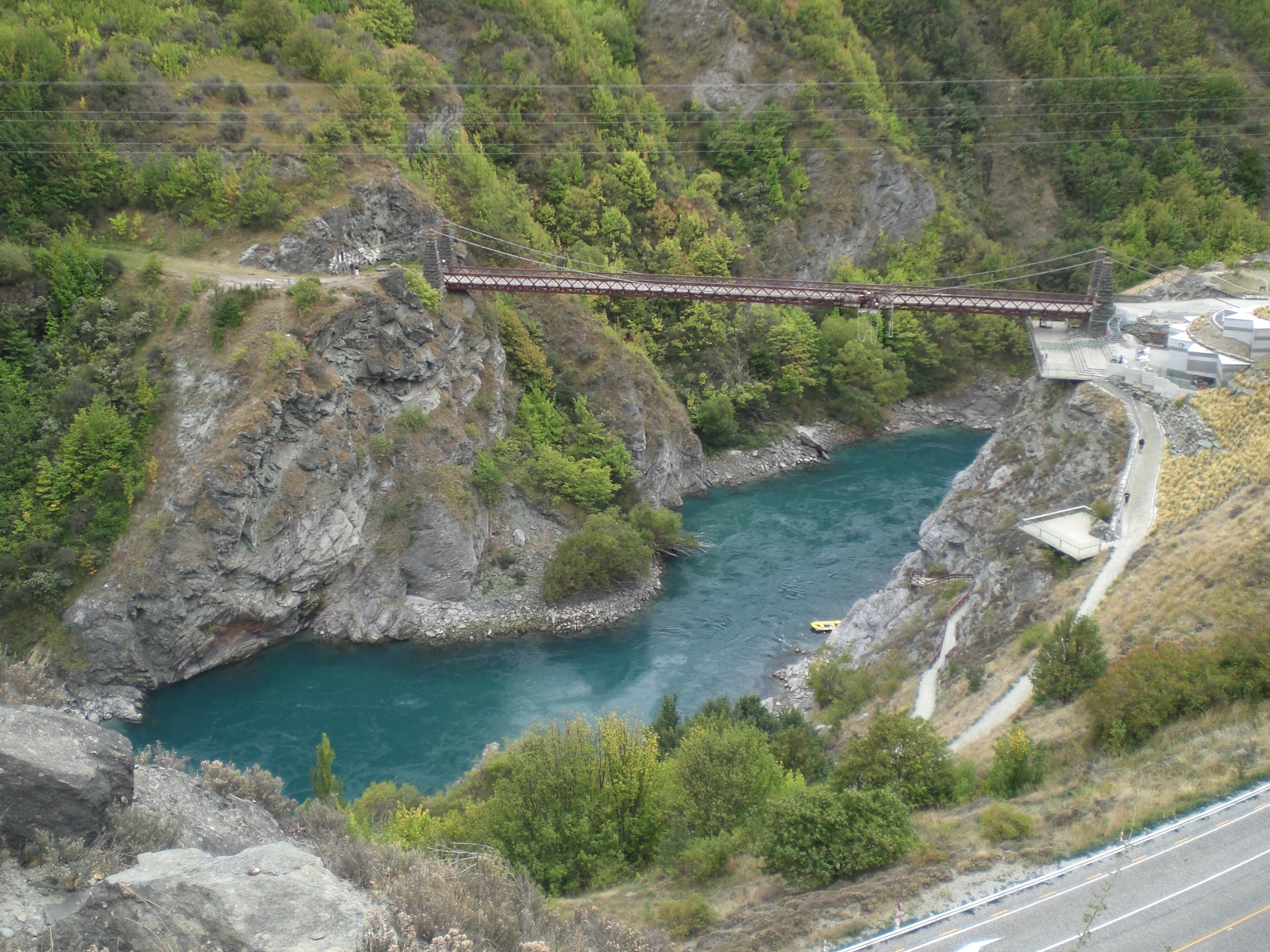
            I did get to see someone else bungee jumping, which was interesting.   This was during a raft trip on the Kawarau River, and our route took us under the AJ Hackett Kawarau Bridge Bungee Jump, which is supposedly the oldest commercial bungee-jumping operation anywhere in New Zealand.   The platform looks to be maybe 60 or 70 meters above the river.    Alerted by the bungee operators, our group of rafts pulled over into an eddy to watch the next jump.   The bungee-er did a very graceful swan dive off the platform, free-falling for maybe two seconds before the elastic of the bungee started to slow his fall.   He bounced up and down on the end of the tether a couple of times, and then was lowered headfirst into a yellow inflatable raft, where the bungee operaters began untying the bungee rope from his legs.   It actually looked more graceful, and potentially more fun, than I had expected.   However, at $180 per 3-second jump, bungee-jumping is undoubtedly one of the most efficient ways to spent money in Queenstown.

Kawarau Bungee, photo courtesy Wikipedia


            The most scenic part of the Kawarau river that we rafted was a canyon early on, which was filmed as the River Anduin in the Lord of the Rings movie.   For a film sequence that is not terribly lengthy, the film crew were apparently shooting  in a lot of locations – this is now the fourth river I have come across that is purported to be the River Anduin.   For my money, the Kawarau has a pretty good claim – the canyon is where the Argonath statues were digitally inserted; that’s pretty definitive.   The Argonath canyon is a lot smaller than as portrayed by Peter Jackson, and it’s a little less impressive to think of that film sequence now that I know that the AJ Hackett bungee jump platform is lurking just out of the frame.   

            The raft trip was about three hours, and very nice.   The canyons were pretty; we saw a lot of Paradise shelducks, and the rapids weren’t too bumpy.   We did end up with a backseat driver in my boat, who didn’t seem to have a very high level of confidence that our guide could actually steer the raft without help.    One of the nicest thigns about this rafting company was that they had a sauna waiting for us when we got back and changed out of our wetsuits.   It felt a lot like visiting the Iceberg lodge’s drying room, except without heaps and heaps of wet gear dangling all over the place.    

Christchurch Botanic Gardens


           Earlier today in Christchurch I went to the Botanic Gardens and rented a kayak to paddle up and down the Avon river.   Even for a public park, there were a surprisingly large number of Mallard ducks on the river, all of whom seemed abjectly terrified of my eight-foot plastic boat.   This seems strange, since the ducks have had all of the tourist season to get used to the boats paddling around.   The ducks were still suspicious; they would take off in noisy, panicked groups, fly twenty or thirty meters ahead, and drop back onto the river, only to take off again in a hurry as I paddled closer.   

Herding ducks on the Avon


            After returning the boat, I spent some time walking around Christchurch, or the parts of it that aren’t still cordoned off.    Being a pedestrian in the city can be difficult due to the number of construction and demolition sites, most of which have quite understandably sprawled across the sidewalks and parking lanes surrounding their building.   Walking west from my hostel, the sideways on both sides of the street are blocked off, necessitating a significant detour onto the side streets if you want to get anywhere.   The older, historic buildings have suffered particularly; most are in the process of being rebuilt or demolished, along with most of the downtown’s skyscrapers.   This includes not only Christchurch Cathedral, but many of the city’s old churches, as well as the Canterbury Museum, the Christchurch Performing Arts Center, and the Christchurch art gallery.   At one of the gates into the red zone, two men in construction hats were chatting with a man in a Gandalf-style robe and pointy hat.   I’m not quite sure what he was doing there - but considering what the city’s been through, I think a little wizardly aid would come in very handy.

            One thing that has sprung up in Christchurch in the wake of the earthquakes are all sorts of temporary structures, based out of garden sheds, shipping containers, converted camper-vans, large tents, and two large geodesic domes that look like Tievak versions of the Epcot golf ball (this is the current performing arts space.)   I got dinner tonight from a Thai restaurant run out of a shipping container that is parked on the concrete pad from what used to be their restaurant.    In fact, is has become so common for displaced restaurants to move into shipping containers that it seems to permeate the Christchurch vocabulary.   As in ‘Then you turn left at the second container on Beally Avenue’, or ‘It’s a big place; they have six or seven containers.’

Butterfly, Botanic Gardens


            So, a quick life update before I finish this post: I am flying out of New Zealand tomorrow, and will be spending a few days in West Virginia visiting family and friends before getting back to Alaska late next week.   I’ll be in the Seward/Moose Pass/Cooper Landing area visiting Alaska friends and family, before heading out to the Iceberg Lodge sometime in mid-May.   My car is still buried in snow, though my cousin reports that the car’s roof is now visible for the first time in several months, so I guess there’s progress.

Friday, April 20, 2012

Glowworm Grottos and Fluffy Blue Dinosaurs


            I’m back from a very, very abbreviated hike on the Kepler track; walking approximately one sixth of the track, thanks to a knee injury from last week’s adventures in Milford.   The Kepler Track is a 60 kilometer tramp, and one of Fiordland’s three Great Walks, and is usually hiked over four days.   The trail climbs up the side of Mount Luxmore, follows an alpine ridge with views into the South Arm of Lake Te Anau, drops into the Iris Burn valley, follows the Iris Burn to where it empties into Lake Manapouri, then follows the Waiau River (famously rich in both vowels and brown trout) back to Te Anau.   The walk is famous for having great views over the alpine section, and is considered by some trampers to have both better and more varied scenery than any of the other Fiordland great walks.   

Waiau River, from a viewpoint near the Rainbow Reach shuttle bus stop


            In this instance, the best thing I’ve found about the Kepler Track is that, unlike the Milford Track, hikers can hike the trail in either direction, and spend as many nights in huts as they wish.    (On the Milford Track, everyone hikes in the same direction, and stays one night in each hut; no exceptions.)   

            The Kepler Track also has public transport, via bus and water taxi,  that accesses a few points on the trail, allowing trampers to trim a few kilometers off of the beginning and end of their hike if they wish.    I spent two nights at Moturau Hut, which thanks to the Tracknet shuttle bus, only requires six kilometers of hiking to get to.   The hut is very pretty, located right on the side of Lake Manapouri.   The place sort of felt like a lakeside resort, only without the resort.    I took most of the day to walk in, resting often wherever there was a convenient log with a view.   There were a few scenic vistas over the Waiau River, which doubled as the River Anduin in the Lord of the Rings movies.   Also, the wetland marsh that the trail crosses is billed as being similar to the nearby marsh that was the film location for the Dead Marshes.   (I’m told that the Hobbit movie film crew was back in Te Anau earlier this year, but I haven’t heard where, or what, they were filming.)   

Wetland boardwalk on the Kepler Track


            The next day at Moturau Hut, I walked a small section of the trail leading to the mouth of Iris Burn, but mostly I spent the day hanging out on the sandy beaches bordering the lake.   Right now, there is a lot more beach on the lake than there usually is, thanks to three weeks of dry weather, and an accompanying low water level.   Manapouri is very pretty, and is dotted with a number of small islands.   This lake was the center of a huge New Zealand environmental controversy in the 1970s, when plans were made to raise the level of the lake by thirty meters as part of a hydroelectricity scheme to power a smelting plant on the south coast.    In a dazzling stroke of engineering genius, the plan that was finally implemented involved not raising the lake, but lowering the hydroelectric plant – it is 200 meters underground, and the entire scheme was designed to produce electricity from the lakes, while still keeping their water level within natural levels.   It’s the second largest electric plant anywhere in New Zealand, and according to the signage at Lake Te Anau, there is no other hydroelectric plant like it anywhere in the world.  

Sunrise, Lake Manapouri


           The one epic failure of the Kepler trip was that the book I took with me was horrible, and there were only so many informative DOC publications in the hut…   I had ample time to read all of them.   I now know that there is a small kiwi population in the area of the Iris Burn hut, and the DOC is trying to increase their trapping program to entice kiwi to move into areas of the park closer to Te Anau.   Their aim in doing so is partly to allow more people to hear wild kiwi, without having to hike for two days to get into their habitat.   (There have occasionally been kiwi heard at Moturau Hut, where I was, off and on, but none that appear to stay in the area permanently.)   Also, the Kepler track is home to a colony of long-tailed bats, one of New Zealand’s only species of indigenous mammals.  The bats were discovered last spring by the kiwi researchers who, just for fun, took a bat detector with them on one of their kiwi surveys.   The colony is near Rocky Point, and that section of trail is now home to an intensive rat-trapping program – which has trapped as many as 70 rats in a month in the vicinity of the colony.   

            The Kepler Track is also close to the area where takahe were re-discovered in 1948, after being presumed extinct for nearly fifty years.   Takahe are a species of endemic, flightless birds, who graze on the high alpine areas in New Zealand’s more remote mountains.   At six pounds, they’re the largest living species of rail anywhere in the world, and have a huge red bill, and a natty blue sheen to their plumage.   Not having kept the ability to fly, the takahe have slowly evolved their way into something resembling a diminutive, fluffy blue dinosaur.   I was lucky enough to see several takahe at Te Anau’s birdlife park, which runs a breeding program for these birds.   There is still a beleaguered population of a few dozen wild takahe living in the hills above Te Anau, which has now been supplemented by introduced populations on four small predator-free islands.

Takahe; photo courtesy Wikipedia


            The first night at Moturau Hut was fairly busy – perhaps thirty people in the hut, a dozen of whom were American exchange students on spring break from a program in Wellington.   The next night, there were only five in the hut – most of the people who were walking down from Iris Burn hut elected to bypass Moturau Hut in favor of walking another six kilometers and catching the shuttle bus back to Te Anau.   This is the last week that the huts will be staffed.   Although the huts are available for use in the winter, DOC will be closing down the gas cookers and the plumbing.   Even around Te Anau, you can tell that it’s well and truly the beginning of the off-season.   I think Easter was probably the last gasp.

            I think Te Anau would be an interesting place to spend the off-season because it seems like there is a pretty active winter community.   I spent some time with a group of Anglican church ladies here - I set up their sound system for then on Easter Sunday, and they in turn invited me to a craft night. The ladies are already busy planning community dinner-and-movie nights, as  well as a ‘Christmas dinner’ to be held in June or July.   (This further strengthens my notion that holidays here ought to be celebrated during the season of the year they were originally meant to commemorate - i.e. Christmas in winter, Easter in spring – not on a specific calendar date.)   There are also community markets, and live concerts being advertised for the coming months.   On the whole, not a bad place to hang out, which is good, since hanging out is mostly what I’ve been doing the past few days.

            After returning from Moturau Hut, I visited the Te Anau glowworm caves.   The caves are on the far side of Lake Te Anau, accessible by a boat trip across the lake, followed by small-group tours of the cave itself.   Some aspects of the tour were pretty unique – it is not often that a visitor would willingly sit silently, for several minutes, in total darkness, all for the purpose of looking at bugs.   The glowworm cave itself was impressive – the passages were very narrow, and the bottom of the cave is still basically a river; this part of the cave isn’t old enough to have dried out.   There were a also number of small waterfalls, cascading from one pool to another.   The glowworm cave was discovered in 1948, and had already become a tourist attraction by the 1960s.   Judging by the early pictures, the cave was equipped with basically the same sort of set-up that is used today – raised wooden catwalks over the floor of the cave, and a boat  ride at the far end out to see some of the thicker constellations of glowworms.   

What the boat tours would look like with the lights on.   This is taken from Real Journeys' website, as photography, being disruptive to the glowworms, is not permitted inside the cave


            Our tour group crab-walked through a very low entrance, and through a few hundred meters of cave passages on raised boardwalks, arriving at the glowworm pier after about ten minutes.   There, we got onto small dinghies, and were ferried further into the cave in total darkness, lit only by the lights of the glowworms themselves.   We stopped under one of the thickest clusters, sat and watched for a few minutes, and then slowly boated back to the pier.   It must be interesting learning how to navigate a boat using only worm-light; I asked one of the guides later, and she said that they follow a rope that’s been strung along the wall of the grotto, using it to pull the boats along.   All other course corrections are made by shoving off of rocks, and bumping into things.   Of course, it would be hard to get terribly lost in the grotto – the passage isn’t very long, and there isn’t another exit, at least, not one above the water.   The whole cave system itself extends through seven kilometers of known passages, many of which can only be accessed with scuba gear.    

            Since the visitable portion of the cave is so small, and the dinghies only seat 14 people, there were actually five different cave tours making their way through the passages, all with slightly staggered start times.   The guides seemed pretty deft at juggling the groups around – but the guide I was with definitely sounded like she had been giving the same glowworm spiel dozens of times a day for a few too many months.    She wasn’t bad, or unfriendly by any means – just possibly a little too burnt out on glowworms.   Or a little too burnt out on tourists; sometimes it’s hard to tell.